Showing posts with label storm. Show all posts

Wednesday, 4 June 2025

Of Princely Fawns and Dark Magicks (short story)

 Of Princely Fawns and Dark Magicks

Deer reader, I implore you to listen to my tale.  It is one of horror and grief, of immorality and dark magicks.  It is something that has changed me, and this world, forever, and in ways that may not yet be apparent.  It is a warning.  A curse.  I promise, deer reader, that my tale is the whole and sane truth, as fantastical as it may seem, and I have refrained from any embellishment of the events that I will divulge in the following paragraphs.

I beseech you to take heed.

My tale begins on a cold and wet October evening, and I must admit that it was far later than any respectable gentleman would consider acceptable or appropriate.  Forgive me, I will not explain my lateness; I am aware of the rumours surrounding my private life, and they are neither relevant nor important to my tale, and whatever the tabloids would have you believe about my personal relationship with the disgraced Sir Reginald Winthorpe, I stress it has no bearing on the events of that night.  I will only concede that he was somewhat responsible for my lateness and my dishevelled appearance.

I was in a hurry to get back to my lodgings that night.  The rain was only a cold mist, though I could observe a storm maturing in the distance, black ominous clouds boiling above the forest just outside the city.  I hadn’t had the forethought to carry my umbrella, only my cane, and I didn’t relish the thought of being caught out in the expected deluge.

The streets were quiet, strangely forlorn of their usual clientele.  I didn’t consider this too odd; I surmised that the ruffians, dolly mops and mollys, and those undesirables that often dressed the roadside, had sought shelter from the coming storm.  Hindsight makes me wonder if the true reason was the sinister destiny that was to cast its shadow over that night.

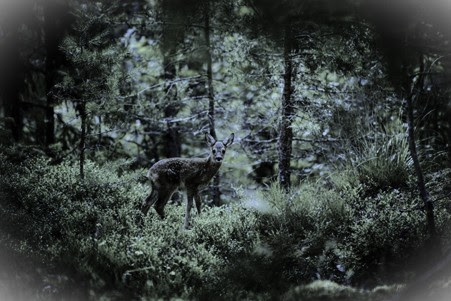
It had sauntered out of the shadows, the beast, and into the dim lamplight, with seemingly no intent to shock me, yet shocked I had been.

I’d struck out at the thing with my cane, hitting down at its skull with deadly force beget by my fright.  Unfounded fright, it seemed.  The innocent fawn died instantly.

I won’t torment you, deer reader, with a morbid description of the pained bleat it emitted with its dying breath, or the terrified glaze in its eyes as the spark of life extinguished.  I won’t tell you how its small body collapsed to the floor like a marionette with its strings slashed.  There was no blood, but the dent in its crown left no doubt as to its fate.

I had killed it.

One does not expect a young deer, nor an adult deer, to be wandering the streets, particularly at night.  I had never expected to cross paths with one in this city; I had only ever encountered them on summer constitutionals in the countryside, and even then, it was a rare occurrence.  I’d seen foxes and rats trawling the streets at night, but never deer.

That is the excuse I tell myself to this day for why I did what I did.  For why I dispatched the poor creature in my momentary fear.

There is no excuse for the deplorable actions I undertook afterward.

At this point I need to pause my tale and provide some context to my life and background, which may go someways to explaining my motivations.  Though, in truth, I cannot tell you why I did it, for even I did not really understand; I may only be lying to myself to ease my troubled conscience.

As a child my mother would read to me every night.  Fairy stories.  Stories of transformation, of other worlds just beyond our own, of immortals and magic.  Spirits hiding in nature, watching us, judging us worthy of heaven.  Or unworthy.  Perhaps that is why I sought out the macabre.  Perhaps not.  I had not been immune to sin even before that night, and I never would be again.

I never stopped believing in those stories.

My favourite of my mother’s fables, that I often fondly recall since her passing, was that of a fairy prince that had been transformed into a fawn, cursed by his father to learn humility.  Though it is only through love that he returns to his true form.  This tale struck close to my heart because my own father had been distant and angry during my childhood and barely acknowledged me even on his deathbed.  He’d always been ashamed of me and what I became.  My father took that shame to his grave.

It was the story of the fawn that came to mind as I stood in the gloomy street on that wet autumn evening and stared down at the corpse of the innocent beast.

I felt overwhelming remorse at my actions.

I have mentioned, deer reader, that I had not been immune to sin, but it may surprise you to hear that I have previously employed use of a hag and her dark magicks.  I fear my life would be far more scandalous than the simple sordid rumours about myself and Sir Reginald, if not for her occult assistance, without which it is likely I would be telling you this story as I turn the crank in jail.

I understand that ‘hag’ often conjures up a crooked crone, but I assure you that she was anything but.  My hag was a beautiful young maiden, though wise beyond her years.  I still remember the knowing look in her eyes, as if she knew what I required of her that night, as I stood on the threshold of her home at the edge of the city, soaked through, for the rain had picked up as the storm approached, holding the beaten creature in my arms and holding back my tears.

I’d watched in awe and anticipation, warming and drying myself near her fireplace, as she cast sorcerous spells and hellish hexes over the corpse, as she poured thaumaturgical tinctures down its throat, rubbed ungodly unguents into its skin.  She’d warned me that there were no guarantees, that not every soul could return from the void, but I’d gripped tight to hope, even as the storm, perhaps an omen of what was to come, reached the city and thundered and roared above our heads.

Her efforts, deer reader, were for naught.

I paid my dues and departed into the tumultuous night, holding the dead fawn, whose life had been cut short by my rash actions, tight against my chest as I faced the wind and the rain.  The heavens poured.  Lightning graced the skies, heralded by thunder.  My grief consumed me as much as the storm enveloped me and my deceased charge.

I wandered for I didn’t know how long, trudged through the squall, freezing and wet, until I found myself at the edge of the forest where I’d first seen the black clouds that now devoured the firmament above.

I knew what I needed to do.  I would bury the poor beast, deep in the forest, return it to whence it came.

I recall being somewhat grateful for the cover of the trees, sheltered from the wind and rain, as I walked my dark fated path.  The storm raged above the canopy, crashing a syncopated rhythm through the flora; it deafened me, forced me to dwell on only my own thoughts, my guilt, my memories of fables about the princely fawn and of the reality of my wanton killing of the deer in the streets of the city.

I’d wanted nothing more than to be washed of my sins, or at least of the sin I’d committed against nature this night, to lay this child to rest and pray for its entry to heaven, but, deer reader, my goodly intentions paved an inevitable path.

I’d tripped, caught my foot against a stray branch or stone, and the dead little deer had been freed from my arms.  I’d found my balance quickly, my hands bracing against a nearby tree, but the fawn had not been so lucky.  I’d inadvertently thrown the creature across the forest floor, its limp body splashing into the muddy ground ahead.

I’d cried out in anguish, my words overwhelmed by the cacophony of the storm.

The unfortunate creature deserved more than being left out in the rain alone, and I fully intended to continue my task.  Something stopped me, deer reader.  Perhaps some sixth sense.  Perhaps my soaked skin restricted my muscles.  Perhaps a ghostly hand gripped my heart and saved me.

The body of the baby deer twitched.  Then its legs kicked out against the muddy forest floor.

I wondered, for a moment, if it had been my imagination, a trick of the gloomy light, hallucinations of my tired brain, but no.  Remember, deer reader, that I told you that I would tell you the whole and sane truth.

It lived.

The fawn, formerly deceased by my own hand, clambered unsteadily to its feet as if it were a newborn.  I watched, stuck to the spot, rain still breaching the leaves overhead, thunder rolling, occasional flashes of lightning illuminating the deer and its caved in skull.

I want to say that I felt some elation in that moment, joy that the animal was alive, glee at my guilt resolved; I tried to force the feeling into my heart, but only an ominous sense of dread gripped my gut.

The fawn was staring at me, one eye distorted by the concave head.  It stood defiantly in the rain, unblinking, unmoving, knowing what I did, accusing me of its murder and the depraved dark acts I’d subjected to its vulnerable body in my attempt at atonement.  This beast was no prince in disguise.

It was a devil.

Thunder rumbled above us.  Me and it, both frozen against the night.  Me, in terror, and it, like a predator deliberating its prey.  I wanted to run, wanted to retreat to the safety of the city, but I could not will myself to move.

Lightning shimmered in the creature’s eyes, and I will swear, deer reader, on my beloved mother’s grave that the glaring pupils lit up with a supernatural crimson glow in that moment.

Then, the fawn bleat a blood-curdling malevolent cry against the storm, against my presence and my actions that dark night, and disappeared into the forest with an uneasy gallop.

I never saw the damnable beast again, despite my every effort, and despite its curse that followed me this past decade.  Those close to me died, sporadically over the years, each death sudden and unexplained.  Even my precious Sir Reginald Winthorpe had succumbed.  You might accuse me of seeing patterns where there are none, of self-fulfilling prophecies, or of madness brought about by my guilt.  But none could explain how each friend, each family member, my lover, had been found collapsed in the forest, their crowns crushed, like the very beast I’d attacked on that cold and wet October evening.

I know, deep in my soul, that it will come for me soon.

And so, deer reader, while I still live to tell you of my terrible tale, I entreat you to take note, to never act rashly against the creatures of this Earth, to never invoke unnatural dark magicks; one may find a prince, or one may find a devil.  And if you ever see a ghastly deer, with its skull battered and bashed, and red glowing eyes, I bid that you run.

The End


Sunday, 29 December 2024

Flower-stein’s Monster (short story)


Flower-stein’s Monster

(Random 2-word prompt- toss, specimen)


                Thunder boomed.  Lightning crackled across the gloomy clouds, and lit up his small, dingy room.  The sounds of the storm were short and sudden respites from the torrent of rain that hammered against the walls and roof of the castle, and a distraction from the howling winds that roared through the forest and found their way into all the cracks and cavities of the large stone building.

                “Gwhahahahahahahahahahahahahahahahahahahahahahahahahahahaha!”

                The manic laughter filled the lonely and empty halls.  It echoed against decrepit paintings, rotted furniture, and neglected rooms.  Candles flickered at its touch… or maybe that was the wind.  It was the song of a crazed and genius mind.

                It continued.

                Flower thought that the Doctor didn’t know when to stop; the laugh always lasted longer than it had any right to.  He stood up and closed the book he’d been squinting through; it was too cold and too dark to read, and he’d persisted as long as he could, struggled through the anticipation of tonight’s coming events.  And now was the moment he’d been waiting for… almost.  The Doctor would be calling for him any second now, given the intensity of the crazed cackle.

                The laugh continued, and then a breathless voice called out: “F…F… Flower!  Flower!  I’ve done it!  Ha hahaha!  The time is now!”  Flower heard the Doctor break into a coughing fit as he headed out and up the steps to the tower.  “Come hither and help me change the very definition of life itself!  Gwhahaha!”

                “Doctor Smithenstein.”  Flower bowed his head to the tall and skinny man as he entered the lab.  The Doctor was hunched and bald, only a few scraggly white hairs poked from his scalp; his body bore decades of wear and tear from late nights in the lab where he’d focused on a singular purpose, his life squandered away like the fortunes he’d inherited.  He was as decayed as this old castle.  It remained to be seen if it was all worth it.

                “Ah Flower,” he said with a dramatic flourish of his rubber-gloved hand.  His white coat, a little too small on his bony frame, strained against the movement.  “Ready the switches, open the circuits, and release the chemical mix!”  He laughed his maniacal laugh.  “The storm is nearing its apex!  We must be ready!”

                “Yes sir.”  Flower hurried to the large haphazard machine pressed up against the left wall; it’d been put together from all sorts of things, found things and reclaimed things, and the recycled LEDs and bicycle lights blinked and flickered.  An old ship wheel turned and pulled ropes attached to several car wheels, churning a spectrum of coloured liquids in vials and containers of various sources and sizes.  Flower flicked a row of switches, each different, and mechanisms whirred into life behind the recycled metal chassis.

                “Gwhahahaha!”  The Doctor ducked beneath the cloth covered table, the table where the small specimen had been lain, and adjusted the wires and pipes.

                Flower opened the circuits, pulling the big lever on the side of the device, ducking from the sparks, and moved to the other side ready to release the chemicals.

                The storm raged above, and the clouds, visible through the skylight, thundered and roared.  Rain beat against the glass in sheets.  Lightning flashed, and for a second the dim lab was lit by more than just candles and flickering lights.

                Flower opened the valve on the first pipe, and a glass milk bottle emptied its thick red liquid.  He opened a second.  Yellow liquid drained from an Erlenmeyer flask.  And a third, green from an upturned vodka bottle.  Fourth, purple from a glass orb.  Fifth, sixth, seventh, and so on, different colours from different containers.  Liquids poured and mixed into a vat near the Doctor and his specimen, and a huge metal arm stirred and blended the concoction.

                Doctor Smithenstein laughed as he stood.  “Gwahahahaha!”  Did he ever stop laughing? “The time is at hand!” he exclaimed.  “Flower, raise the lightning rod!”

                Flower shuffled across the room, and he watched as the Doctor filled a large syringe with the chemical mixture from the vat.  He placed his hands on the crank and began to wind it as the scientist worked on the small creature under the sheet; blood would be replaced by the chemicals, electrodes connected to its neck.  Flower wound the handle.  It was hard work.  The long metal pole rose higher and higher as he sweat and strained, the skylight opening on cue, as rain drenched him and the stone floor around him.  The storm was getting worse, as expected.  Thunder quickened, lightning arced.  The rod locked into place and Flower stood back.

                “And now, we wait,” grinned the Doctor.  He stared up at the night sky, eager anticipation upon his brow.

                Nothing happened.  Flower watched as Doctor Smithenstein became more and more anxious as the minutes ticked by and more nothing happened; the scientist wrung his hands in the candlelight, struggled to hold his grin, cast regular furtive glances at the dead specimen hidden under the cloth on the table.  The weather was as angry as ever; it had to happen soon!

                And it did!

                Lightning struck the rod with a loud zap, the room flashed with a bright light… and everything went dark, candles blown out by the storm.

The room smelt of blood, or was it just the aroma of electricity?  Thunder rocked overhead, and the only other sounds he could hear were the thrash of the rain and the thrum of his heart.  He held his breath; he didn’t know what to expect.

And then the maniacal laugh broke what remained of the silence.

                “Gwhahahahahahahahahahahahahahahahahahahahahahahahahahahaha!”  The Doctor’s face was lit by a small flame, a match.  “I’ve done it!” he shouted.  “Life!  I’ve created new life!”

                Flower moved around the room, relighting the candles as the laugh continued, bringing dim light back to the damp lab.  The scientist’s arms remained raised in triumph as the assistant approached the table, ready to see the results of the Doctor’s experiment.

                “Flower,” said Doctor Smithenstein, eyes charged with lightning.  “Remove the sheet and let us see what magnificence my brilliant mind has wrought.”

                Flower did as he was ordered, whipping away the fabric with the theatrical embellishment expected of him.

                “Oh.”  The Doctor’s shoulders dropped, his hunch hunched lower, and a frown fell down his face.

                On the lab’s table lay the specimen.  Dead.  It had been dead to begin with.  Roadkill.  Flower had felt sorry for it, and that’s why he’d brought its corpse to the Doctor, for a new life, but somehow the baby deer looked even deader than it had been before, with metal bolts in its neck, and stiches on its head and limbs.  It had been enhanced by science and technology, and had been failed by it too.

                The poor creature remained dead.

                Doctor Smithenstein cried out, hand to his forehead like a betrayed lover, and he fell to his knees and sobbed.  “F… Flower… I’m useless.”

                “No sir.”  Flower couldn’t stop looking at the corpse on the table.  Poor thing.

                “Toss the specimen,” bawled the Doctor.  “And take the rest of the night off; I… I… need to be alone.”  He placed his head in his rubber-gloved hands and broke into more tears.

                Flower knew better than to stay, especially when his boss was in this sort of mood.  He quickly scooped up the dead specimen in his arms, holding the cold baby deer close to his chest, and headed out of the lab and down the tower steps.

                He could hear the Doctor’s manic crying, no longer a laugh, echo through the lonely and empty halls and amongst the sounds of the storm, as he descended further and further down the stone steps.  He felt a little guilty for bringing the deer to the Doctor.  And though it had been dead already, he’d allowed its corpse to be desecrated and mutilated in the hopes that science could resurrect a young creature whose life had been cut short.

                Flower would bury it in the forest; he couldn’t just toss it away like Doctor Smithenstein had suggested.  It deserved better.

                He held the specimen… the baby deer…  tight against himself as he unlatched the door and crept out into the squally night.

                The rain and wind hit him hard, soaking him through as he fought his way into the cover of the trees.  He was cold, freezing.  His boots squelched through the mud, and he struggled to see a clear path.

                Flower tripped in the dark, catching his foot against a stray branch, and the deer fell from his arms.  Its small limp body rolled across the ground before coming to a halt.

                “Noooo!”  He stretched out his arm to the body, but it was just out of reach.  He crawled along the muck toward it.  The little thing deserved more than being left out in the rain alone.

                The baby deer twitched.

                Flower stopped in his tracks, rain pouring down his face; he wiped water from his eyes.  Had he imagined it?

                The baby deer’s legs kicked against the forest floor.

                Flower’s jaw dropped.  He could taste the mud, the rain, the electricity in the air.  He couldn’t believe what he was seeing; the Doctor’s experiment had been a success.

                It lived.

                The specimen, the formerly dead creature, clambered unsteadily to its feet.  It appeared to tower over Flower’s prone body, despite its diminutive size.  The baby deer stood defiantly against its death.  It was alive.  Thunder and lightning careened overheard, and for a moment, the bolts and metal stitches glinted in the sudden illumination.

                “You’re alive!”  Flower laughed, fighting the urge to mimic the Doctor’s manic cackles.  “You’re alive!  You’re really alive!”

                At moments like this, he knew what he was expected to do, what he’d been employed to do; he’d need to recapture the specimen and return it to the lab.  But his heart won out.  He couldn’t do what was expected; he had to do what was right.

                “Go,” he said.  He gestured at the baby deer to move.  “Run, run away from here.  Go.  Now!”

                The creature stared at him with a deep intelligence.

                “Go!  Just go!”

                The deer ran.  It stopped several metres away and looked back at Flower.

                Thunder.  Lightning lit up the sky.

                It stood there, and he felt a sudden unease.

                The specimen’s eyes glowed red and it shrieked a blood-curdling cry against the storm.  It disappeared into the night, and Flower’s empathy became terrified regret.

The End.

Next Flower Story